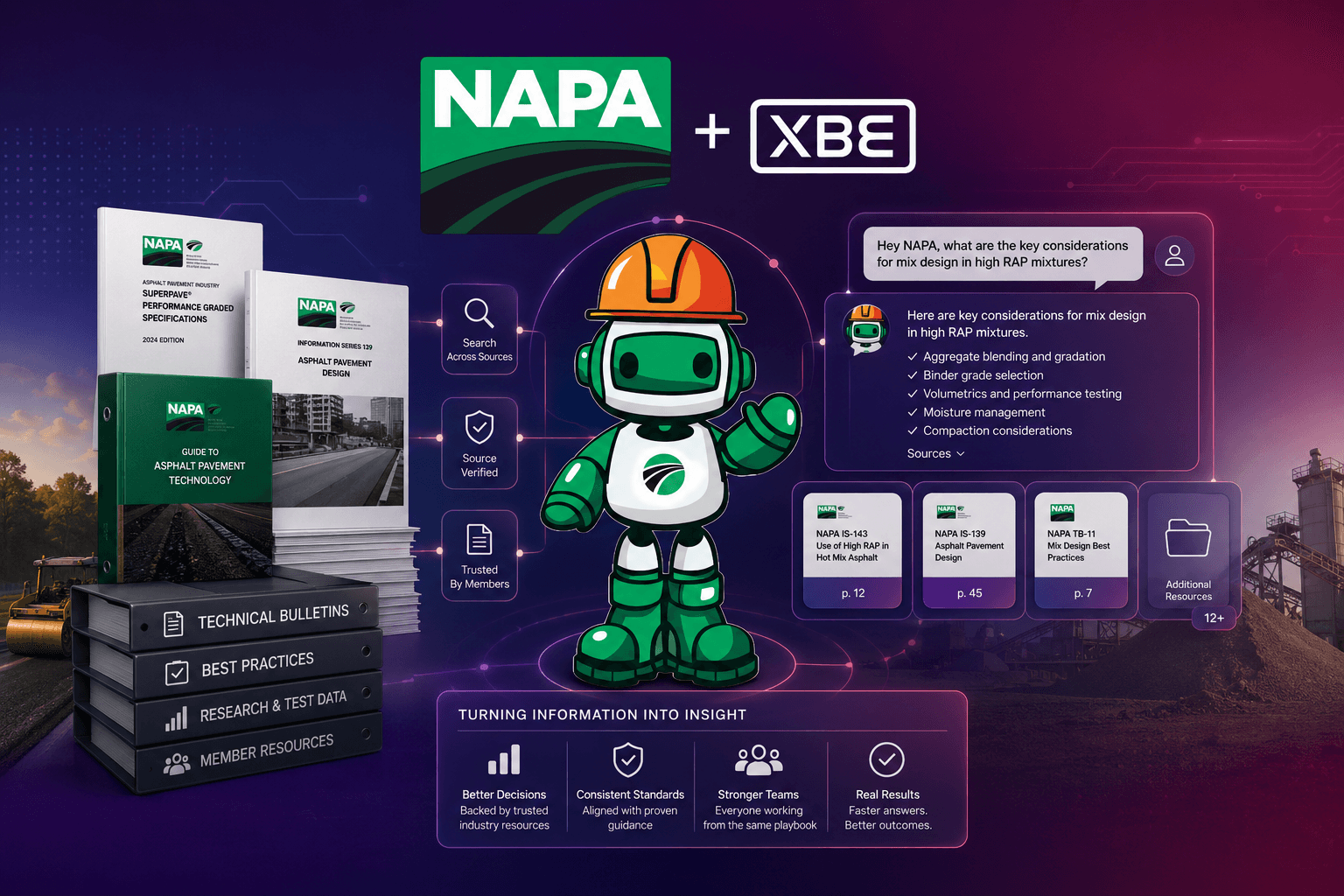
When the National Asphalt Pavement Association launched Hey NAPA in July 2023, the goal was practical: make it easier for members to find answers inside a deep and growing body of technical knowledge. Built in partnership with XBE, the tool addressed a real problem: too much information, too much friction, and too much distance between a question and a usable answer.
Nearly three years later, that original use case still matters. But the more interesting story is what it reveals about AI adoption itself.
NAPA's work with Hey NAPA is more than a member-service success story. It is a case study in responsible AI adoption: starting with a real need, moving quickly through partnership, and growing stronger through iteration.
Those lessons came through clearly in a recent conversation with NAPA leaders Brett Williams and Richard Willis, who reflected on how Hey NAPA started, why it resonated so quickly, and where NAPA sees the work going next.
A Real Problem, and the Right First Use Case
Hey NAPA did not begin as a technology experiment. It began in an engineering committee conversation about a practical issue: members were navigating technical topics buried in documents, standards, and details, and NAPA needed a better way to help them get to the right information faster.
That matters because many AI efforts begin in the wrong order. They start with the technology and then go looking for a use case. Hey NAPA moved in the opposite direction. NAPA identified one clear pain point first: how to disseminate critical technical knowledge more effectively as the volume of material kept growing and members needed clarity now.
That focus made this the right first move. It also makes the story larger than one tool. In that recent conversation, Richard Willis put it simply: "choose one thing, get really good at that, and then move on to the next."
It is hard to find a better summary of responsible AI adoption than that.
Built Quickly, Because the Need Was Clear
NAPA is the center of this story. But the partnership with XBE is an important part of why it moved so quickly.
Once the use case was clear, XBE helped NAPA turn the idea into a working member resource. From the initial concept to launch, Hey NAPA came together in less than six months. The speed stands out, but not because speed by itself is impressive. It stands out because the problem was well defined. NAPA knew what needed to be solved. XBE helped make that solution usable, member-facing, and immediate.
That clarity also shaped the reception. In the same conversation, Brett Williams said there was "a lot of interest right away," people started using the tool quickly, and the user base has grown steadily over time. Richard described a real buzz after the Midyear rollout. That kind of adoption does not usually happen because something is novel. It happens because it is useful.
Why It Worked
Hey NAPA is a strong example of why AI adoption should be approached with effectiveness before efficiency.
AI does not automatically fix everything. You do not get durable value just by deciding to "use AI." The first job is to solve a real problem well enough that people trust the result. That is what NAPA did. Hey NAPA was built to make technical information easier to access and easier to verify. It helped members not only get answers faster, but see where those answers came from.
At a time when many public AI tools were fast but not always transparent, that mattered.
Because it was effective first, it earned usage. Because it earned usage, it created room for iteration.
That may be the most transferable lesson in the story. Good AI adoption is iterative, but it does not earn the right to iterate unless people trust the first version. In Hey NAPA's case, that trust came from solving a real problem in a way that was grounded in sources rather than hidden behind a black box. That made the tool more explainable, more credible, and more useful from the start. From there, NAPA could improve the experience, refine the outputs, explore new use cases, and keep making the tool more valuable over time.
From Answers to Insight
If the first chapter of Hey NAPA was about answers, the next chapter is about insight.
One of the most compelling developments is that NAPA is now building ways to learn from how Hey NAPA is used and give that value back to the community. Brett described an emerging community insights concept built around the most-used resources, top topics, top cited resources, and monthly platform user growth. As he put it, the goal is to "daylight for the community" how the tool is being used and how the community is growing.
That shift matters. It means Hey NAPA is not only helping one person at a time find an answer. It is also helping NAPA see patterns: what members are asking about, where recurring needs are emerging, and what topics may deserve stronger resources or more guidance.
That is where the story becomes more strategic. Not because Hey NAPA alone created NAPA's broader AI posture, but because it became a practical accelerant. It helped turn interest into operating experience, gave NAPA a visible proof point, and helped the association learn faster.
Leading by Example
Another reason this story matters is that NAPA is not just encouraging members to think about AI. It is using AI internally, working through governance questions, and building a culture of responsible experimentation.
Richard noted that the engineering team has already run internal workshops on how these tools can help, and described a push from leadership for each department to identify at least one use case that could improve communications or workflows. Brett also described a draft AI policy and guiding principles built around encouragement, paid tools with stronger protections, and a clear boundary around sensitive information. In his words, "we should be using it, exploring it, but we need to be doing it where... data is protected."
That balance is important. The message is not to adopt everything. It is not to move fast and ignore the risks. It is to explore, learn, and improve while protecting trust, protecting data, and respecting what members expect from the association. That is part of what gives NAPA credibility when it talks about AI adoption more broadly.
What Comes Next
The most exciting part of this story is not that NAPA launched an AI tool in 2023. It is that NAPA is still asking what comes next: for member service, for internal workflows, for community insight, and for AI adoption more broadly.
That future is already taking shape. NAPA is looking at how Hey NAPA insights can feed more resources back to the community. It is encouraging internal teams to keep experimenting. It is helping widen the AI conversation across the asphalt ecosystem, including state associations that are beginning to ask what similar approaches could look like for their own members.
Brett captured that larger direction clearly when he said AI is moving beyond simple question-and-answer interactions and toward "tools to increase efficiency or help processes."
That is the larger shift Hey NAPA helps illuminate. It started as a focused solution to a technical information problem. It became a useful member resource. And now it is helping accelerate a broader, more mature conversation about what responsible AI adoption can look like in practice.
NAPA's next chapter will not be defined by Hey NAPA alone. But Hey NAPA has clearly been one of the catalysts that helped speed it up.
That may be the strongest lesson in the story: responsible AI adoption does not begin with a promise to transform everything. It begins with one real problem, one useful solution, and a willingness to keep improving once the value is clear.